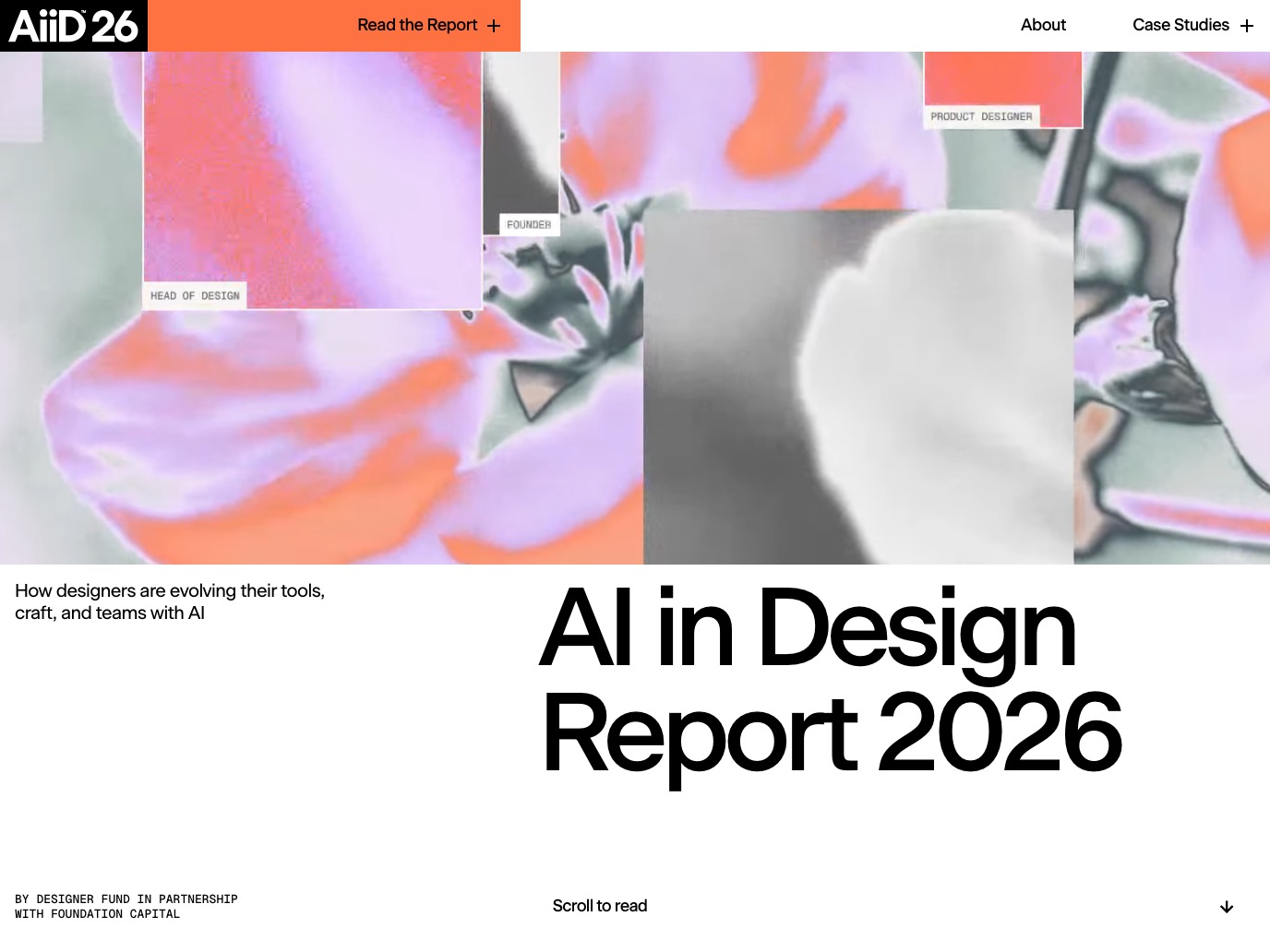
AI in Design Report 2026
Once a year, Designer Fund and Foundation Capital measure how AI is changing design work. For the AI in Design Report 2026 they surveyed 906 designers across more than 60 countries and conducted over twenty interviews with design leads. It is the most decisive edition yet — and, spoiler, a remarkably optimistic one.
Because the numbers don't tell a displacement thriller. They tell of a profession that has claimed new tools and gained room to move: 53 percent say AI has positively transformed their relationship with work. Four learnings stand out.
01 — The experiment has become the everyday
91 percent use AI at least weekly, three out of four daily. A year ago it was barely more than half.
The toolkit is growing with it: seven AI tools per person on average, more than twice as many as in 2025. And something has shifted at the top — the most-used AI tool in this group is now Claude.
02 — Designers ship
Half of the respondents have pushed AI-generated code to production. Not just design engineers — product and brand designers. 76 percent work with coding tools like Claude Code or Cursor, and 43 percent say their company now expects working prototypes instead of static mockups.
The screenshot as a deliverable is in retreat. What counts is what can be clicked.
03 — Your own bar remains the bar
The biggest obstacle according to the report: unreliable output quality, named by 62 percent. The answer isn't a better machine but an old strength — 80 percent rely on their own quality bar, not the AI's. Taste, judgment and user understanding are the skills the report names as the ones that matter most now.
If that sounds familiar: it's the same gap this journal has written about before. Nice to see it quantified.
04 — Learning happens next desk over
70 percent learn their AI practice from peers — a year ago it was 24. Three quarters draw their knowledge from newsletters and communities. Only 16 percent wait for recommendations from above, half as many as the year before.
The transformation is not a top-down initiative. It happens at the desks — and companies are letting it: 87 percent support AI adoption at least moderately, more than half actively with budget and programs.
What remains
Of course, work is shifting. 65 percent take on more product and engineering tasks, roles are blurring, 73 percent feel expectations rising. The report doesn't hide that. But its underlying melody is confidence: designers who build themselves are twice as likely to feel more creative and capable than before.
I also read the report as quiet confirmation of my own way of working — not because I saw all of this coming, but because what proves itself here in the everyday now matches the experience of 906 colleagues. There's hardly a better argument for continuing.